TL;DR:
In 1938, a broad coalition of Canadians, spanning diverse political and social ideologies, unified in Toronto to protest against a fascist rally organized by newly merged Canadian fascist groups. This marked a crucial moment in developing an antifascist consensus in Canada, showcasing widespread public opposition to domestic fascism amid the international rise of totalitarian regimes.
Synopsis:
On the evening of July 4, 1938, Toronto faced a significant antifascist demonstration in response to a rally organized by Canadian fascist groups at Massey Hall. The event was a pivotal moment as three fascist organizations merged into the National Unity Party (NUP), with plans to propagate their ideology across Canada. This convergence of fascists attracted strong opposition from a wide array of political and social groups, including communists, Trotskyists, anarchists, liberals, conservatives, and social democrats, who had grown intolerant of fascism due to the aggressive expansionism in Europe. Previously, antifascist opposition in Canada had been limited to specific communities like Italian and Jewish groups; however, by 1938, a broader coalition of Canadians united against domestic fascist threats.
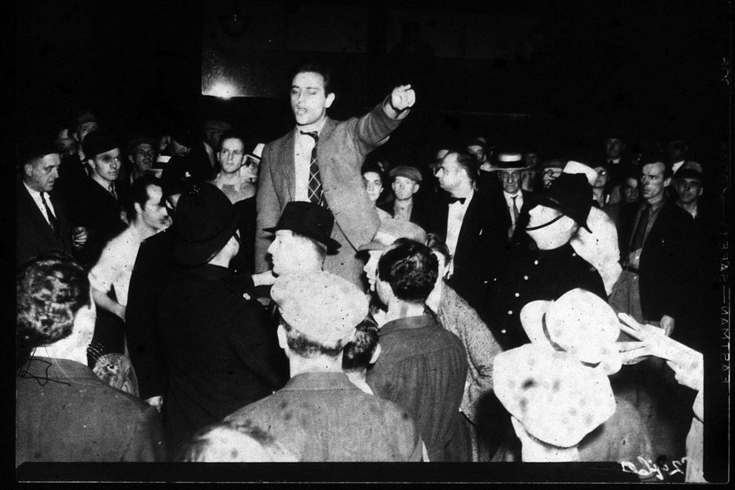
The police had been on high alert due to prior antifascist disruptions and the expected deployment of 100 “stormtroopers” by the fascists for self-protection. On the night of the rally, the city saw a massive turnout: thousands of Torontonians, from various political and social backgrounds, took to the streets in a unified front against the fascists. At the same time, within Massey Hall, fascist leaders, including the newly elected leader of the NUP, Adrien Arcand, delivered speeches denouncing Jews and extolling nationalist rhetoric.
Meanwhile, outside, three distinct antifascist protests were organized. The most direct was by the Provisional Committee for Anti-Fascist Action, led by the Trotskyist League for a Revolutionary Workers’ Party, whose rally was broken up by mounted police when it threatened to march on Massey Hall. Additionally, the Canadian League for Peace and Democracy and the Co-operative Commonwealth Federation held rallies aimed at promoting unity and democratic cooperation against fascism. These events illustrated a critical moment in the development of a Canadian antifascist consensus, showing a shift to mainstream opposition against fascist ideologies.
The response to the fascist threat in 1938 highlighted the challenge and the necessity of coalition-building across ideological lines. It demonstrated that although leftist groups like Trotskyists and anarchists were significant organizers, more conservative factions also joined the cause, recognizing the peril posed by fascism. This antifascist consensus, emerging against domestic and international fascist aggression, was crucial in Canada’s pre-World War II history, ultimately contributing to government actions against fascist groups when Canada entered the war.
Leave a Reply